
Manual- Short Game
Here you have your Short Game Tools.
Knowing your short game distances is very important to get into the lower scores territory. I see it so many times, myself included ofcourse. Second shot just short of green and when you chip good you can make an easy up&down. But there are more short shots distances then your number of golf club in the bag. Is it a PW half swing, LW to my hip or SW 1/4 swing. How and what shot to use. How far back and what wedge to use. And under pressure, not in the garden with a beer in your hand.
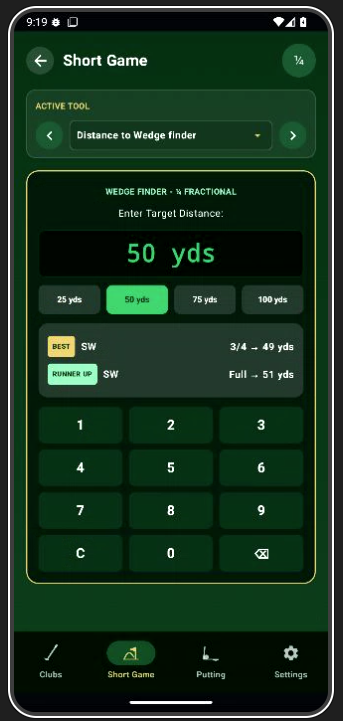
There are 5 different Short Game Tools for getting you to make the right decision what wedge to hit for the distance you need. We all know that when it comes to short game accuracy you need to know exactly how far to make your backswing and which wedge to use to get the desired distance to get it on the green, pin high, for a easy tap in put. Making more pars, birdies and less triples and bogeys is where the short game tools make you help achieving it.
PGA Pros use this concept all the time, now you can too. Just knowing your Short Wedge Game distance from various approaches is the key behind it. Their caddies has this data in their cheat sheets and select the right club wedge and tell them how to execute the backswing using a system to have them fly the golf ball laser sharp to the pin. Keeping your buddies amazed how you pull it off is a extra bonus for your glorious tap in par (Did I hear a birdie?).
To make the right short backswing for the distance you need to get the golf ball to the pin, you have to know how far to make that backswing every time, all the time. PGA Pros use a matrix framework for this. They use a clock, percentage, fractional or body points for keeping consistent all the time. With the Golf Club Caddie Tools by SOG you have these same PGA Pro wedge matrixes with your own distances available.
There are 4 type of backswing references. The Clock.
 The Percentage (%).
 The Fractional.
 The Body Points.
Each one can be individual assigned the distances the ball travel when you use that particular backswing reference point. This can be done in [settings]…[
In the upper right corner you will see the round button with the active short game backswing reference.
When you press this button it will cycle to all the 4 system you can choose for yourself to use.
The clock system.
The clock system divides your backswing segments like a analog clock. If you stand and visualize a round clock vertical around you. Then 12 is on top of your head and means a full swing. 1 O’clock just about a full swing little less. 3 O’clock is like a halfway swing.
The percentage system.
The percentage system (%) divides your backswing segments in percentage of the full swing (100%). Like 50% swing is a halfway backswing.
The fractional system.
The fractional system (1/4) divides your backswing segments in fractions of your full swing (1/1). Like 1/2 swing is a halfway backswing.
The body points system.
The body system (Head, Hip, Knee, etc.) divides your backswing segments in relation to a certain body point. Like your head would be a full swing and your hip would be a halfway swing.
These systems refer to a certain point in the backswing length. You can choose for yourself how you feel what that means for you of course and use the corresponding system. For me, a 3 o’clock swing means my wrist is at halfway length (1/2) in the fractional system which in turn is my hip using the body point system and it would be 50% in the percentage system.
This way you always know how far to make the backswing to get the consistent distance of the shot needed. Magic for your buddies, but dialed in for you and easy to lookup in the Short Game Tools at your disposal.
These number you can change also to your own preferences. 3 o’clock you can name 15:00, 1/2 into 4/8, 50% into 60% and shoulder into armpit for instance. This you can do in [Settings] where there is the [Short Game Settings] option to do so.
There are 4 usefull Short Game tools for you available.
l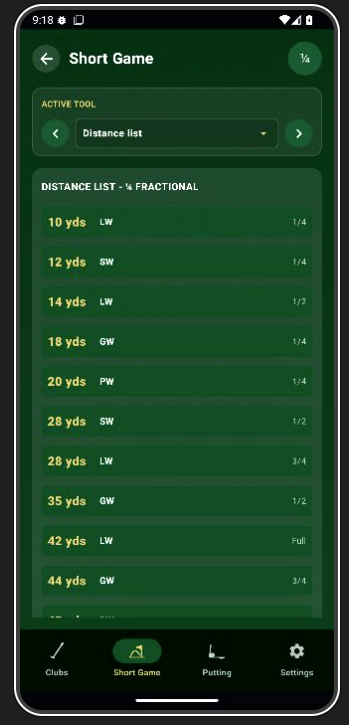 The Distance list.
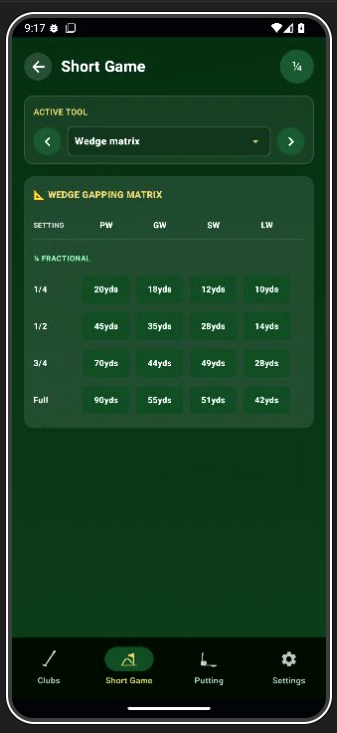 The Wedge matrix.
; The wedge selector,
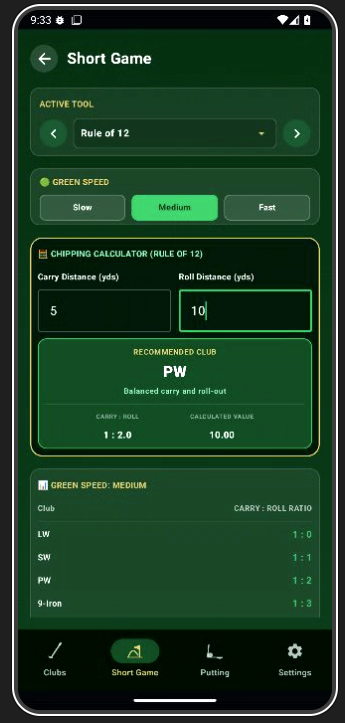 The Rule of 12.
You can edit these